Elematic Developed Leadership with Strong Results
Elematic is the world’s leading manufacturer of precast concrete technology. With more than 65 years of experience, the company designs, manufactures, and delivers top-class machines, equipment, and automation solutions for the precast concrete industry. Elematic’s technology covers the entire precast concrete production process from design and manufacturing to delivery and installation, helping customers improve productivity, sustainability, and profitability. The company’s customer base extends to more than 100 countries. Its headquarters and one of its production facilities are located in Akaa, Toijala, and it also has production facilities in Riihimäki, Alwar in India, and Changzhou in China. Elematic employs approximately 300 people worldwide, and its revenue in 2024 was 50 million.
A New Strategy as the Starting Point for Development
“Our new strategy toward sustainable growth was published in 2024, and one essential part of it is leadership development. Our people play a key role in implementing the strategy and delighting our customers. We had a clear need and desire to develop the leadership skills of our managers and thereby strengthen our culture,” says Teppo Voutilainen, CEO of Elematic.
“We had not had leadership training for some time, so the need for development was significant in that respect as well. We felt in particular that managers needed a shared operating model for leadership. We were convinced by Blanchard Finland’s expertise and the Blanchard SLII® leadership model available through them,” continues HR Manager Maarit Jamrozinski.
“The key goals for the partnership launched with Blanchard Finland were to increase managers’ leadership competence, strengthen our leadership culture, create high-quality communication, and inspire people to achieve exceptional results. Ultimately, the aim is to achieve better business results and increased job satisfaction among teams and team leaders,” says CEO Voutilainen.
Focusing on Practical Frontline Leadership
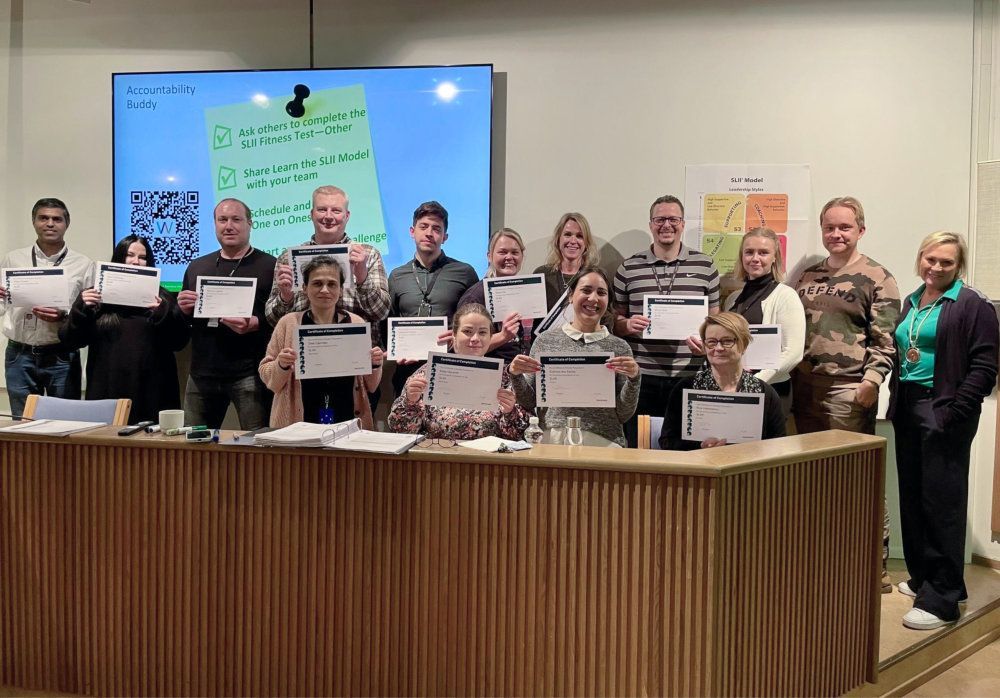
An approximately 11-month leadership training program was designed and implemented for Elematic. The program included the most essential and important frameworks and tools for practical frontline leadership.
The training program included in-person and online training, digital online courses, guided application, as well as supporting self-assessments and feedback surveys. The learning journey was built in the Blanchard Exchange learning portal, where participants could easily access different tools and guides and expand their learning, for example through short exercises lasting just a few minutes.
The learning journey included the following main themes and tools:
SLII® — taught leaders how they can help people succeed by providing the right amount of direction and support at exactly the right time, in other words, by using a leadership style that matches each person’s needs.
Building Trust — taught leaders and gave them concrete tools for building trust and restoring lost trust.
Coaching Essentials® — taught leaders a coaching process and skills designed for practical frontline leadership, and provided tools that help them increase productivity and create an atmosphere of trust and autonomy.
Johtamistaitojen arviointi II (LAPII) — provided information on leadership effectiveness, flexibility in the use of leadership styles, and respondents’ satisfaction with their manager’s leadership style and the organization. A self-assessment and employee assessment were conducted at the beginning and end of the training program.
Everything DiSC® — helped leaders create more effective interaction both personally and at the organizational level.
Evaluating the Impact of the Training Program
To evaluate the impact of the training program, a measurement strategy was created, defining the methods and measurement points for impact assessment. The impact evaluation focused on assessing the impact of the SLII® model, which played the central role in the training program.
The impact of the SLII® training was assessed in two different phases. In the first phase, the development of participants’ competence and commitment was evaluated in certain key knowledge areas and skills, such as goal setting. This was carried out immediately after the SLII® training.
In the next phase of the impact assessment, the focus was on behavioral change and the resulting improvement in performance and results. This took place 90 days after the SLII® training, and employees also participated in the assessment alongside managers.
A separate leadership skills assessment, LAPII, was also used as part of the impact evaluation. The survey provided information on the participants’ leadership effectiveness, flexibility in the use of leadership styles, and employees’ satisfaction with their own manager’s leadership style and the organization. The LAPII self-assessment and employee assessment were conducted at the beginning and end of the training program. At Elematic, the impact evaluation will continue through quarterly assessments of managerial work.
Significant Results with the SLII® Leadership Model
Ninety days after the SLII® training, 87% of managers estimated that they had improved separately defined leadership skills, and 69% of employees estimated that their own manager had improved these skills after the SLII® training.
After 90 days, 82% of managers estimated that applying the leadership skills and leadership behaviors learned in the SLII® training had improved their team’s performance. Team performance was estimated to have improved by an average of 41%. Among employees, 70% estimated that their own performance had improved thanks to better frontline leadership. Their own performance was estimated to have improved by an average of 33%.
Ninety days after the SLII® training, 91% of managers felt that they had been more committed and motivated in their role as a frontline leader after the training, and 73% also estimated that the training program had improved their commitment to the company. Among employees, 68% felt that they had been more committed and motivated thanks to better frontline leadership, and 54% felt that better frontline leadership had strengthened their commitment to their workplace.
“The decisive factor was to give all managers the same framework and model for leadership. With the help of the SLII® model, we have been able to engage personnel more effectively, as we can identify competence needs and changes in motivation in different tasks and goals. We have also observed improved communication between different units thanks to the new approach to frontline leadership,” says HR Manager Maarit Jamrozinski.
Share this article